


Over the weekend, the New York Times reported a major scoop: the Trump-Vance Administration has a plan in the works to reform the Child Care and Development Block Grant to allow families with a stay-at-home parent to claim eligibility. According to the NYT, the change is a top priority for Vance.
Social media immediately lit up. The Heritage Foundation came out in favor. Democratic House Member Rosa DeLauro immediately denounced the plan, which she called unconscionable, on the grounds that “supporting stay-at-home parents should never come at the expense of working families.”
The most interest split? In my opinion: the intra conservative one. Broadly speaking (although not without exceptions), those in favor of the “New Right” — who will likely line up behind a potential Vance bid for president in 2028 — liked the idea.
On the other side are traditional or Reaganite conservatives (many of whom may oppose a Vance candidacy). They largely expressed opposition to new entitlements and skepticism of government meddling in family matters — all positions the Republican Party has traditionally been associated with, but which are hotly contested as the different conservative elements battle for the future of the party. In short, I think we are seeing on social media a contest over the policy itself, but also positioning for the coming election.
I’m going to put electoral politics aside right now. Instead, turning to the substance of the proposal: Subsidizing stay-at-home parents is a great idea.
We don’t have the specifics of the plan, but supporting families with a stay-at-home parent is one of Vice President Vance’s best ideas, and a long overdue change in how we think about family policy. Carter Skeel at the Institute for Family Studies called it correctly: “Anyone who refuses to admit that this is at least directionally correct either does not care about American families or does not understand politics.” We’ve long failed to provided American parents with meaningful choices on one of the most important questions they face: how should they care for their children?
Why support families with a stay-at-home parent, especially working-class families?
I’ll get into the specifics of this particular grant program later, but for now, just know this: it’s directed primarily at working-class families. In short, it’s for poor people who work.1
Poor families where the parents are married, but Mom (or maybe Dad) is home and the other spouse works are often fighting a bunch of uphill battles.
First, these families usually choose to have a stay-at-home parent for a good reason … not so Mom can eat bonbons and watch daytime TV! Based on research we have done at the think tank Capita, some of these reasons include:
The family has a medically complex child, and needs to go to appointments and therapies multiple times a week. Maybe this child is also immunocompromised and wouldn’t do well in group care settings.
The family lives very rurally, and there’s no child care program within a reasonable drive.
Mom’s job before she gave birth was on the night shift, Dad is working the day shift, and they are losing their minds trying to swing those schedules with an 8-month-old baby (true story reported to me: the exact phrase was “we were f—king dying”).
Dad is working at a job with tons of travel (think: long-haul trucking), the family has five kids, and Mom can’t hold down a normal job given all the kid sick days, doctor check-ups, etc.
This is a partial list, but you get the idea.
These working-class families also face headwinds because our social safety net programs are sometimes poorly set up to deal with them. Often, they’d be a lot better off if they were unmarried, and Mom was applying solo for benefits. Others have written persuasively about the marriage penalties inherent in our tax code and safety nets.
In addition, many of our existing social safety programs are better set up to deal with small families than larger ones. For married families with several kids, for example, it can be quite difficult to access housing assistance — even if they are entitled to it under the rules — because landlords are less likely to have three-or-four bedroom units to rent to those with housing vouchers.
Many people think of families with a stay-at-home parent as better off than two working parent families because one parent is home and has more flexibility, but that’s not necessarily true. Many of our best benefits — including health benefits, and other kinds of fringe benefits — are routed through the workforce. A family with two parents working full-time jobs might have better access to these critical employee benefits (it all depends).
Therefore, it is quite hard to compare families with a stay-at-home parent and one with two working parents, because even if family income is identical, much depends on non-income specifics. What kind of health insurance do they have access to? Does the employer offer tuition assistance or a retirement match? Etc.
We’re getting pretty deep in the weeds here. The bottom line: families with a stay-at-home parent can be struggling, even when they’re working hard. Don’t picture that Ballerina Farm lady in a field wearing a flowing dress. Picture instead: a Dad working at a local factory, Mom home with two little kids, one of whom needs speech therapy 2x per week, and a monthly budget where they are sometimes deciding between gas and groceries.
In short, these are families that need help, but they often fall between the cracks. Policymakers historically haven’t been very interested in them. I am thrilled that Vance and others in the Administration want to help them out —we are long overdue for a national conversation that these families need a hand up.
Is this childcare block grant program the right way to help?
If you’re not a libertarian, perhaps I have convinced you that families with a stay-at-home parent could use some government help. Is a child care grant program for lower- and working- class families the place to do it?
Let’s start with what these parents actually want. Polling says that most of them want their kids cared for at home. The most persuasive evidence on this was collected by American Compass in 2021. With credit to them, this is what the polling looks like:
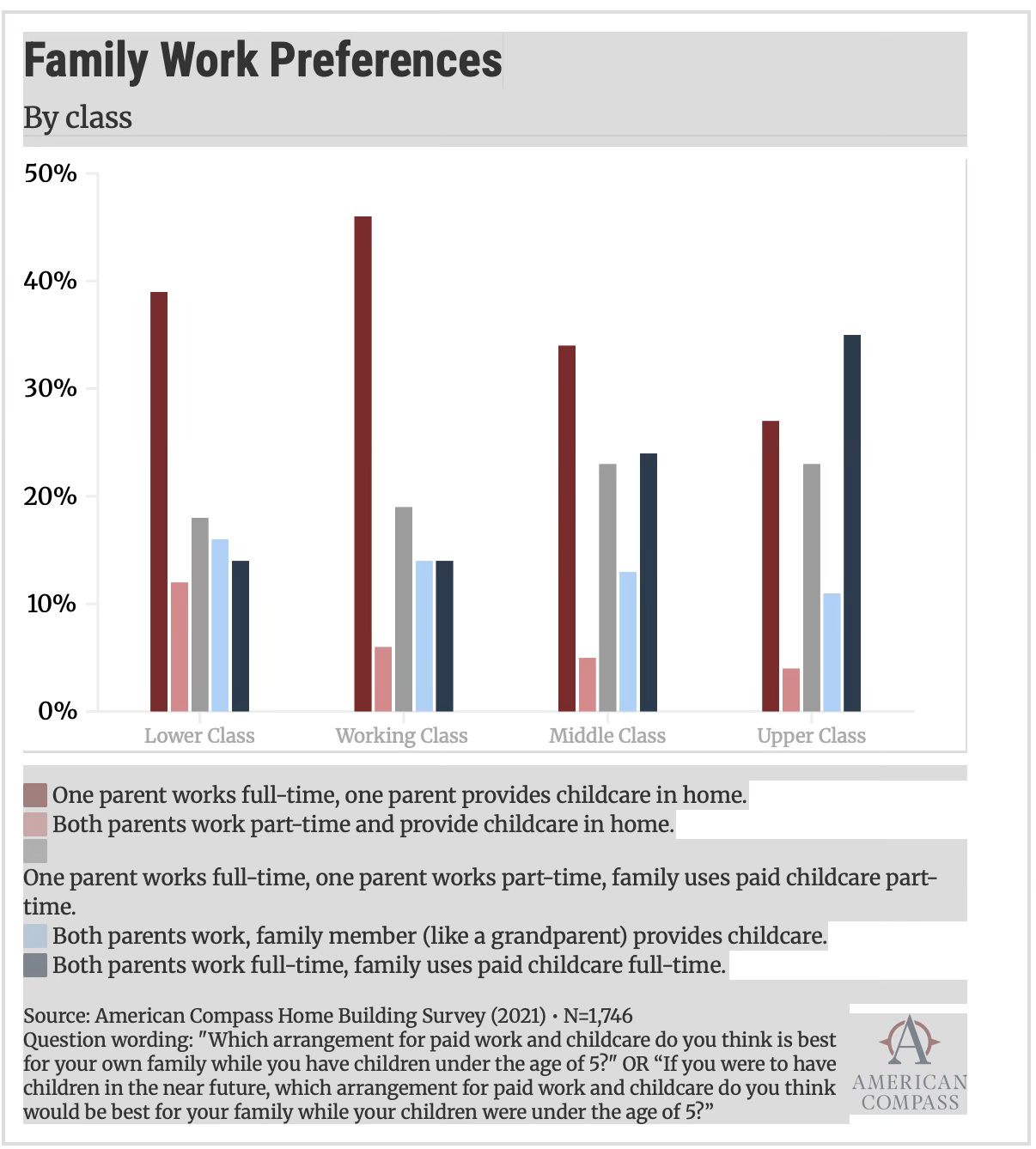
As you can see from this chart, when you look at working- and lower- class Americans (the kind of people who would have access to this type of grant), by far the most popular option is to have one parent in the workforce and one parent at home. The only socioeconomic group in which a plurality of people want to have two parents working full time and the children in external paid child care … is the upper class.
I found the quote below from the New York Times article disclosing Vance’s plan to be really illuminating. The author, Coral Davenport, interviewed a child care provider on the issue.
Krystal Gastineau, the owner of Cribs 2 Crayons, a child-care center in Aurora, Colo., said that about half the children she cares for receive the subsidies, which are paid directly to Ms. Gastineau’s business via direct deposit. “If they could, I think parents would choose to take the money and stay home,” she said. “That would take away a major source of income.”
“I think that’s a misuse of the system,” she said.2
I have a lot of respect for childcare providers, who are doing good and important work. However, I also think that in setting family policy, we should ask first what parents want, and then base the system around that.
But instead of setting up a childcare system that provides pluralistic options (including making it possible for small kids to be cared for by Mom or Dad if the family so desires), we’ve set up one that has other priorities.
Moreover, this doesn’t need to be a partisan issue. Research we have done suggests that many stay-at-home parents have a diverse range of political beliefs. In a round of polling we conducted recently, we found that every politician has constituents who are stay-at-home parents: 40% of respondents identified as Republicans, 37% as Democrats, and 24% as independents or “other.”3
To be sure, there are potential objections. Perhaps the enabling text of the statute at issue doesn’t actually allow for the solution the Administration is trying to create, as my colleague Elliot Haspel has pointed out here.
Additionally, the block grant at issue has a fixed amount of funding. If families with a stay-at-home parent can qualify, that means families with two working parents, or a single parent, will be competing for the same limited pot of funds.
Obviously, in an ideal world, we’d have enough resources for everyone that needs help. I’d prefer if this change came with a significantly larger amount of funding, and share concerns expressed by others about whether families that are already eligible would be negatively impacted. However … as I’ve said in Part One here … often families with a stay-at-home parent really need help also.
Which kinds of families need help more? I don’t think there’s an easy, one-size-fits all answer to that question.
To be clear: any real assessment of the specific planned change would require diving deep into the details, which have not been publicly disclosed (and may not even have been worked out yet). How much would families with a stay-at-home parent be eligible for in funding? Which families would qualify? What are the true tradeoffs between existing families and those who would be newly qualified? Would the Administration seek more funding from Congress? What does the statute at issue allow for? Without concrete answers to these questions, accurately weighing the pros and cons is impossible.
Primarily, though, I want us to recognize that on the field of American family policy, the Vance team is throwing the ball in the correct direction. The Administration is reacting to a long-existing unsolved problem, and to a group of families that need help and should get it. Whether they can get the ball in the end zone is unclear, but I’m glad they understand the need.
When I write for other publications, they almost never let me call these families “poor”, but since that’s what they usually call themselves, I’m going with that self-assigned label.
I added the bold and italics in this quote for emphasis.
These are rounded numbers; a sharp eyed reader may note they add to more than 100%.
I just really dislike the implication in this policy debate that stay-at-home parents eliminate the need for childcare. It would be an enormous step in the right direction if there were more public acknowledgment that the role of SAHP involves more than childcare, and that for most people the responsibilities involved can be better fulfilled with some kind of external childcare support. I’m a SAHM to a special needs kid, and we can only function well as a family because I use about 15 hrs/week of a childcare (some paid, some not). And I would say that even that isn’t nearly enough, especially in the summer. Even if you take special needs out of the picture, SAHPs also need and deserve regular respite care.
I wholeheartedly agree, I just don’t see why it has to be done at the expense of working single moms. That struck me as a culture war provocation. Also curious if same sex couples will be eligible.